Featured Medical-Grade Orthopedic Implants & Instruments
Precision-machined from certified Ti-6Al-4V ELI titanium and implant-grade PEEK, thoroughly evaluated through multi-stage bio-stability and mechanical fatigue testing.
Biocompatibility Testing Protocols & Metallurgical Standards in Chinese Medical Manufacturing
In modern orthopedic reconstructive surgery, trauma fixation, and spinal fusion, the biological reaction between implantable devices and host bone tissue governs clinical efficacy. As leading Chinese manufacturers and global exporters, our manufacturing framework bridges advanced metallurgy, mechanical engineering, and exhaustive biological safety evaluation. Implants engineered from medical titanium alloys (Ti-6Al-4V ELI per ASTM F136) and implant-grade Polyether Ether Ketone (PEEK per ASTM F2026) undergo multi-tiered testing protocols to guarantee cytotoxicity mitigation, corrosion resistance, and flawless osseointegration.
1. The ISO 10993 Biocompatibility Testing Matrix for Permanent Implants
For permanent metallic and polymer implants remaining in human tissue for longer than 30 days, biological evaluation must surpass basic toxicity screening. Chinese OEM suppliers operating at international standards implement an integrated ISO 10993 testing matrix to fulfill regulatory criteria across FDA 510(k), EU MDR 2017/745, and NMPA Class III requirements.
| ISO Standard | Evaluation Parameter | Assay Methodology | Acceptance Benchmark |
|---|---|---|---|
| ISO 10993-5 | In Vitro Cytotoxicity | L929 Mouse Fibroblast Elution / MTT Assay | Pass >80% Cell Viability |
| ISO 10993-6 | Local Effects After Implantation | Subcutaneous & Intramuscular Rabbit Histopathology | Pass Minimal Fibrous Encapsulation |
| ISO 10993-10 | Irritation & Sensitization | Guinea Pig Maximization Test (GPMT) | Pass Zero Sensitization Response |
| ISO 10993-11 | Systemic Toxicity & Endotoxins | Acute/Subacute Toxicity & LAL Bacterial Endotoxin | Pass <0.5 EU/mL Pyrogen Threshold |
| ISO 10993-18 | Chemical Characterization | ICP-MS Metal Ion Leaching & GC-MS Extractables | Pass No Toxic Ion Accumulation |
2. Metallurgical Surface Passivation and Electrochemical Anodization
Raw titanium materials inherently possess high strength-to-weight ratios; however, untreated titanium surfaces can release trace Vanadium ($\text{V}$) and Aluminum ($\text{Al}$) ions under friction or acidic body fluid environments. To mitigate ion leaching, our production process utilizes automated Type II Electrochemical Anodization and nitric acid passivation (per ASTM F86).
- Stoichiometric Titanium Dioxide ($\text{TiO}_2$) Layering: Controlled anodization creates a dense passive oxide film (anatase/rutile phase, 50–200 nm thick), turning the metal bio-inert and preventing galvanic corrosion inside the medullary canal.
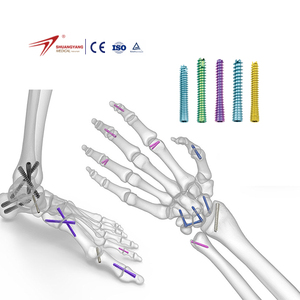
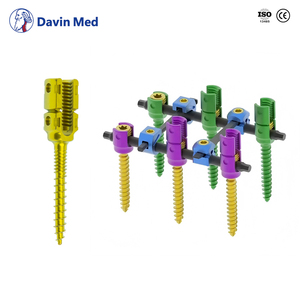
- Colour Anodization for Surgical Identification: Color-coded surface treatments (gold, blue, green, magenta) assist orthopedic surgeons during intraoperative drill bit, tap, and screw size identification without using toxic dyes or artificial paints.
- PEEK Radiographic Markers: Interbody fusion cages synthesized from implantable PEEK are integrated with Tantalum ($\text{Ta}$) or Titanium pins, allowing artifact-free post-operative MRI imaging alongside clear fluoroscopic verification under C-arm radiography.
3. Fatigue Strength Verification & Dynamic Load Mechanics
Bone plates and pedicle screws absorb cyclic biomechanical stresses during physiological weight-bearing prior to fracture union. Manufacturing quality assurance requires finite element analysis (FEA) corroborated by dynamic mechanical testing:
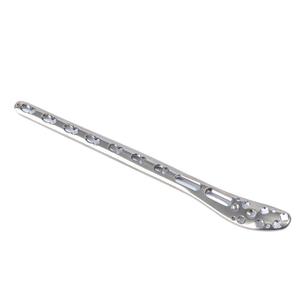
- ASTM F382 (Metallic Bone Plates): Evaluates four-point bending fatigue strength and flexural rigidity. Plates must withstand 1,000,000 stress cycles without micro-fissure propagation.
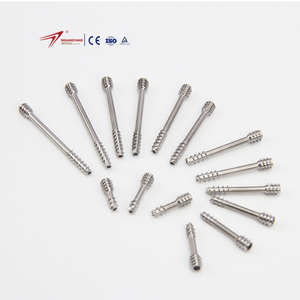
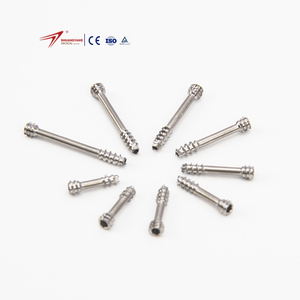
- ASTM F543 (Metallic Medical Bone Screws): Determines axial pullout strength, torsional yield strength, and insertion/removal torque to avoid screw head stripping during bicortical placement.
- ASTM F2077 (Spinal Interbody Fusion Devices): Assesses static and dynamic compression-shear mechanics under physiological spinal load vectors.
Why International OEM Buyers & Distributors Partner With Us
China’s premier orthopedic manufacturing ecosystem combines cost efficiency with rigorous compliance standards, sophisticated CNC machinery, and end-to-end supply chain transparency.
Ultra-Precision Swiss CNC Lathes
Utilizing 9-axis Star and Citizen Swiss-type CNC lathes, our facility maintains machining tolerances within $\pm 0.005\text{ mm}$, guaranteeing precise locking thread engagement between bone screws and compression plates.
Class 10,000 Cleanroom Packaging
Final ultrasonic washing, bio-burden decontamination, and primary packaging are conducted inside certified ISO Class 7 (Class 10,000) cleanrooms to control pyrogen and endotoxin contamination levels prior to ethylene oxide (EO) sterilization.
100% Material & UDI Lot Traceability
Every single bar stock heat number, machining run, anodizing batch, and sterilization lot is recorded under our ISO 13485 QMS system, allowing full Unique Device Identification (UDI) laser marking and tracking.
Comprehensive Dossiers for Registration
Distributors receive complete technical documentation—including material certificates, sterilization validation reports (ISO 11135), biocompatibility test packages, and IFU files—to support local MOH registrations.
Surgical Instrument Customization
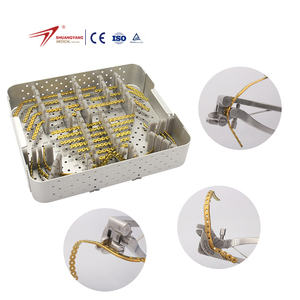
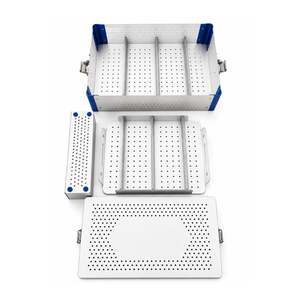
We supply modular, color-coded sterilization cases and stainless steel (17-4PH / AISI 420) instrument trays tailored for trauma, spine, CMF, and veterinary surgical applications.
Global Supply Chain Logistics
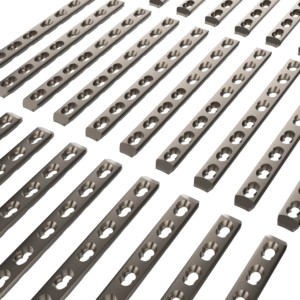
Optimized production scheduling ensures stable inventory levels for high-demand trauma plates and cannulated screws, preventing stock-outs for distributor sales rep networks.
Future Sourcing & Procurement Trends in Global Orthopedics
As healthcare systems shift toward value-based purchasing and stricter regulatory oversight, procurement teams for hospitals and regional distributors face evolving challenges. Sourcing orthopedic implants from top Chinese manufacturers requires evaluating key technology shifts occurring over the coming decade:
A. Additive Manufacturing & Porous Trabecular Titanium Scaffolds
Traditional solid titanium implants are rapidly incorporating 3D-printed porous structures (Selective Laser Melting / Electron Beam Melting). Trabecular titanium geometries feature interconnected pore sizes of 300–600 microns, mimicking human cancellous bone elastic modulus (~1.5–3 GPa). This significantly reduces stress shielding while encouraging vascularized osteo-conduction without requiring additional bone graft substitute.
B. Antibacterial & Bioactive Surface Functionalization
Periprosthetic joint infection (PJI) and implant-associated osteomyelitis remain critical postoperative risks. Emerging implant surface modifications integrate Silver-Doped Hydroxyapatite (Ag-HA), copper ion micro-arc oxidation, and covalent peptide coatings. These advancements inhibit bacterial adhesion (such as Staphylococcus aureus biofilms) while promoting osteoblast proliferation.
C. Regulatory Convergence & Quality Management Transparency
With the transition from EU MDD to MDR (2017/745) and heightened FDA post-market surveillance requirements, low-tier suppliers lacking rigorous technical documentation are exiting the international market. Modern healthcare procurement prioritizes export partners capable of delivering validated cleaning processes, bio-compatibility reports, and lot-by-lot ICP-MS testing records.
Frequently Asked Questions for International Medical Device Buyers
Key technical, regulatory, and commercial considerations when importing certified orthopedic implants from China.
What specific titanium grades are used in your orthopedic bone plates and screws?
Our trauma locking plates and cannulated compression screws are machined from certified Ti-6Al-4V ELI (Extra Low Interstitial, Grade 23 per ASTM F136 / ISO 5832-3) and Commercially Pure Titanium (CP Grade 3/4 per ASTM F67). ELI grade titanium provides enhanced fracture toughness and fatigue resistance compared to standard Grade 5 titanium.
How do you verify the biocompatibility of customized OEM or private-label implants?
Every raw material batch undergoes chemical compositional analysis via Inductively Coupled Plasma Mass Spectrometry (ICP-MS) to verify heavy metal limits. Finished devices are sampled and evaluated per ISO 10993 standards for cytotoxicity (ISO 10993-5), systemic toxicity (ISO 10993-11), and hemocompatibility (ISO 10993-4) before lot release.
Are your instrument sets fully compatible with standard sterilization autoclaves?
Yes. All sterilization boxes (such as our AI-DHS Box Series) and surgical instruments are fabricated from anodized aluminum alloy, Radel (PPSU), and medical-grade stainless steel (17-4PH / 420). They are validated for steam autoclave sterilization cycles at 134°C (273°F) per ISO 17665 guidelines.
What documentation is supplied to support regional Ministry of Health product registrations?
We provide comprehensive technical documentation dossiers including ISO 13485 certificates, CE declarations of conformity, raw material mill certificates, Biocompatibility Test Reports, Biomechanical Fatigue Reports, Packaging Validation (ISO 11607), and IFU documentation.
What is your minimum order quantity (MOQ) and lead time for global distributors?
Standard catalog items (such as standard locking compression plates and pedicle screw systems) maintain safety stock levels with dispatch within 7–14 days. For custom OEM projects or localized private labeling, production lead time typically ranges from 30 to 45 days, with flexible MOQs tailored to regional contract requirements.
Partner with a Leading China Orthopedic Implant Manufacturer
Contact our medical engineering export team today to request complete product catalogs, factory audit protocols, and technical registration dossiers.