CE Certified Orthopedic Implant Company Manufacturer & Exporter
Global Leader in ISO 13485 & CE Certified Medical Titanium Trauma Plates, Spinal Pedicle Screws, PEEK Fusion Cages & Maxillofacial Systems
CE / ISO
13485 Certified
70+
Export Countries
<0.005mm
CNC Swiss Tolerance
100%
Traceable Material
Surgical Portfolio
Featured Precision Orthopedic Implants & Instrument Systems
Engineered from bio-grade Titanium (Ti-6Al-4V ELI) and PEEK polymer for exceptional fatigue strength, tissue compatibility, and rapid osseointegration.
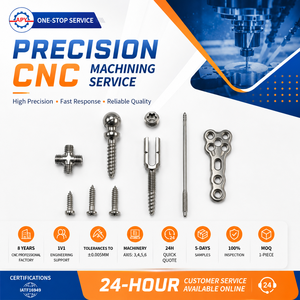
Precision CNC Machined Orthopedic Implants Titanium Bone Screws Spinal Fixation Parts OEM Custom Medical Components Manufacturer
In modern orthopedic reconstructive surgery, the long-term clinical viability of load-bearing bone implants is intrinsically linked to material purity, dynamic fatigue strength, and biomechanical compliance. As an established CE Certified orthopedic implant company, manufacturer, and exporter, our production architecture is anchored in rigid material physics standards—primarily utilizing Extra Low Interstitial grade Titanium Alloy (Ti-6Al-4V ELI conforming strictly to ASTM F136 and ISO 5832-3) alongside Commercially Pure Titanium (CP-Ti Grade 2 / Grade 4 per ASTM F67) and Polyether Ether Ketone (PEEK-OPTIMA®).
"Biomechanical matching between metallic implants and host cortical bone is essential to prevent stress shielding, screw back-out, and aseptic loosening over multi-year clinical cycles."
Titanium Ti-6Al-4V ELI provides an optimal tensile yield strength (>860 MPa) paired with a significantly lower elastic modulus (~110 GPa) compared to traditional 316L stainless steel (~210 GPa). This reduced modulus minimizes the phenomenon of stress shielding—wherein stiff metallic constructs bear excessive skeletal load, resulting in localized osteopenia and compromised bone remodeling. Furthermore, for spinal interbody fusion applications (TLIF, PLIF, ALIF), our PEEK cage systems offer a modulus of ~3.6 GPa, closely mirroring natural cancellous-cortical bone interface dynamics while remaining completely radiolucent under X-ray and CT imaging.
Material Specification
Standard Compliance
Yield Strength (MPa)
Elastic Modulus (GPa)
Primary Surgical Indication
Ti-6Al-4V ELI Titanium Alloy
ASTM F136 / ISO 5832-3
≥ 860 MPa
110 GPa
Locking Plates, Pedicle Screws, Trauma Pins
Commercially Pure Titanium (Gr 4)
ASTM F67 / ISO 5832-2
≥ 480 MPa
105 GPa
CMF Mini Plates, Cranial Mesh, Soft Tissue Anchors
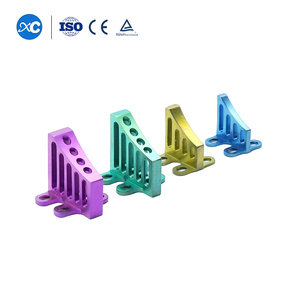
To eliminate fretting corrosion and increase micro-surface hardness, all titanium locking plates undergo Type II Electrochemical Anodization. This electrochemical surface treatment yields a densified protective titanium dioxide ($TiO_2$) passivated layer, markedly curtailing metal ion leaching ($Ti, Al, V$) into surrounding periprosthetic tissue. Additionally, color-coded Type III anodic oxidation is executed across specialized screw diameter matrices (e.g., 2.7mm Gold, 3.5mm Green, 4.5mm Blue, 5.0mm Magenta), permitting immediate identification within high-stress operating room environments and reducing intra-operative error rates.
Enterprise Manufacturing Superiority & ISO 13485 Quality Ecosystem
Quality management within high-risk medical device manufacturing (Class IIb and Class III) demands absolute process repeatability. Our state-of-the-art production facilities house multi-axis Swiss-type automatic CNC lathes (Citizen & Tsugami), 5-axis high-speed milling centers (Matsuura), and wire-cut EDM machinery operating within temperature-controlled, ultra-clean machine environments. Dimensional tolerances across intricate locking thread geometries and variable-angle screw sockets are rigorously held to sub-micron accuracy (<5 micrometers).
5-Axis Swiss Machining
Ultra-precision multi-axis turning enables single-pass execution of complex helical threads, variable pitch cannulations, and anatomical contours without re-clamping distortion.
100% CMM & Optical Inspection
Automated Zeiss Coordinate Measuring Machines (CMM) and video measuring systems verify pitch consistency, contour accuracy, and chamfer radius for every production batch.
ISO Class 7 Cleanroom
Final ultrasonic cleaning, passivating baths, primary packaging, and double-sterile barrier pouch sealing are conducted within verified ISO Class 7 cleanrooms.
End-to-End Regulatory Traceability & Technical Dossier Support
Every single implant leaving our manufacturing floor carries an indelible, non-damaging laser-etched DataMatrix QR code or micro-lot serial number. This enables complete bidirectional traceability—linking installed surgical implants back to the raw material melt heat lot, chemical mill certificate, specific CNC machine operator, anodization batch, and final sterilization validation record (EO / Gamma Irradiation per ISO 11135 / ISO 11137).
For international medical device importers, tenders, and hospital procurement partners, we furnish comprehensive Technical Dossiers fully aligned with European Union Medical Device Regulation (EU MDR 2017/745) requirements, STED (Summary Technical Documentation) formats, and US FDA 510(k) equivalency benchmarks. Our regulatory affairs department provides ready-to-file registration packages including Bio-compatibility Reports (ISO 10993 full series), Mechanical Static/Dynamic Fatigue Testing Reports (ASTM F382 for bone plates, ASTM F543 for bone screws, ASTM F1717 for spinal constructs), and Risk Management Files compliant with ISO 14971.
Future Sourcing Trends & Technological Paradigms in Orthopedics (2025–2035)
The global orthopedic implant market is undergoing a seismic structural transition. Healthcare payers, hospital networks, and orthopedic distributors are no longer evaluating suppliers solely on per-unit product pricing; purchasing metrics have shifted decisively toward total clinical value, supply chain resilience, and technological integration. Key trends reshaping procurement include:
Traditional solid titanium implants are rapidly being augmented by 3D-printed electron beam melting (EBM) and direct metal laser sintering (DMLS) technologies. Porous trabecular titanium surfaces mimic natural human cancellous bone architecture (pore size 300–600 $\mu m$, porosity 60–80%), encouraging direct bone in-growth (osteoconduction) rather than simple on-growth. Forward-thinking distributors must align with manufacturers capable of integrating hybrid manufacturing—combining subtractive CNC machining for precision locking threads with additive manufacturing for biological fixation zones.
2. Dynamic Regulatory Compliance & EU MDR Rationalization
The transition from MDD 93/42/EEC to EU MDR 2017/745 has forced many legacy European original equipment manufacturers (OEMs) to discontinue specialized or low-volume product lines due to prohibitive re-certification costs. This clinical supply void has created immense market opportunities for agile, high-caliber overseas manufacturers who possess robust ISO 13485 quality systems and fully validated clinical documentation. International buyers are prioritizing certified exporters capable of guaranteeing long-term regulatory continuity without disrupting hospital inventory supply chains.
3. Patient-Specific Implants (PSI) & Digital Surgical Planning Integration
Reconstructive craniomaxillofacial (CMF) and complex oncological trauma procedures are moving away from off-the-shelf bending plates toward pre-bent or fully custom patient-specific implants engineered from 3D DICOM CT scans. Modern suppliers must support rapid CAD/CAM reverse-engineering workflows, enabling custom plate fabrication, 3D anatomical model printing, and pre-sterilized surgical cutting guides within accelerated 7-to-10-day export turnaround cycles.
Geopolitical disruptions and air-freight volatility over recent years have exposed the vulnerabilities of lean "just-in-time" stocking models for critical medical devices. Leading global medical distributors are establishing long-term contract manufacturing partnerships with verified Class III orthopedic manufacturers who maintain strategic raw material reserves (titanium bar stock, PEEK rods) and provide guaranteed regional replenishment lead times under 14 business days.
Clinical Application Solutions & Product Line Architecture
Our comprehensive surgical portfolio spans five major orthopedic disciplines, designed to provide seamless intra-operative handling, standardized drill/driver interfaces, and anatomically contoured plate profiles that minimize soft tissue irritation.
Trauma & Fracture Fixation (LCP)
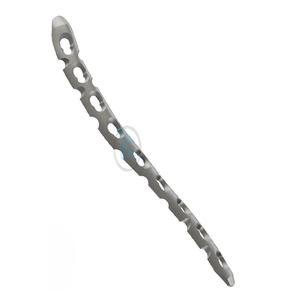
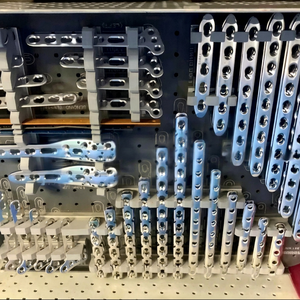
Comprehensive locking compression plate (LCP) systems covering small fragment (2.7mm / 3.5mm) and large fragment (4.5mm / 5.0mm) anatomical sites. Includes proximal humerus, distal radius, superior clavicle, distal femur, and proximal tibia locking systems with combi-holes accepting both conventional cortex screws and angularly stable locking screws.
Spinal Stabilization & Fusion
Advanced thoracolumbar pedicle screw systems featuring polyaxial and monoaxial designs with friction-head stability, low-profile rods, and top-loading set screws. Complemented by cervical anterior plating systems and PEEK interbody fusion cages (TLIF, PLIF, ALIF) incorporating radiopaque tantalum markers for precise intra-operative positioning verification.
Craniomaxillofacial (CMF) Fixation
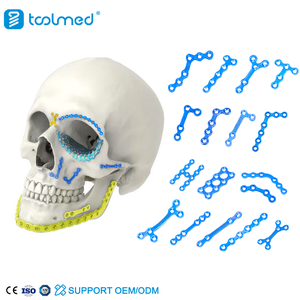
Low-profile 1.5mm micro and 2.0mm mini plating systems designed specifically for midface trauma, orthognathic alignment, orbital floor reconstruction, and mandibular fracture osteosynthesis. Micro-machined titanium plates offer malleability without sacrificing structural rigidity or fatigue life.
Veterinary Orthopedic Trauma Systems
Dedicated veterinary trauma solutions tailored for canine and feline orthopedic reconstruction. Featuring specialized TTA (Tibial Tuberosity Advancement) cages, TPLO (Tibial Plateau Leveling Osteotomy) plates, mini-fragment AO systems, and autoclavable sterilization container kits built for high-duty veterinary surgical suites.
Procurement Guide
Frequently Asked Questions by Global Importers & Procurement Teams
Detailed answers regarding regulatory compliance, OEM custom manufacturing, minimum order quantities (MOQ), and shipping logistics.
What regulatory certifications and documentation packages do your orthopedic implants carry?
Our manufacturing facilities operate under a fully audited ISO 13485 Quality Management System. Our primary product lines carry CE certification under European standards, accompanied by complete technical dossiers (STED format), ISO 10993 biocompatibility testing data, ASTM F382 dynamic mechanical fatigue reports, and Certificate of Analysis (CoA) mill certificates for every titanium melt lot. We routinely assist global distributors with local Ministry of Health (MoH) product registrations.
What raw materials are specified in your bone plates, screws, and interbody cages?
All load-bearing bone plates and locking screws are precision-machined from medical-grade Titanium Alloy Ti-6Al-4V ELI (ASTM F136 / ISO 5832-3) or Commercially Pure Titanium (ASTM F67 Grade 2 & Grade 4). Our interbody spinal fusion cages are manufactured using genuine implant-grade PEEK (Polyether Ether Ketone) featuring integrated radiopaque markers. Raw materials are sourced strictly from certified global suppliers with complete heat-lot traceability.
Do you offer OEM, ODM, and Private Label contract manufacturing services?
Yes. We specialize in comprehensive OEM/ODM custom manufacturing for established medical device brand owners. Our services include custom CAD/CAM engineering, rapid prototype development, custom surface anodization, micro-laser branding (logo, lot code, part number), specialized tray layout design, and custom sterile packaging solutions (blister packaging with Tyvek lids).
Are your implant systems supplied with matching surgical instrument kits and sterilization containers?
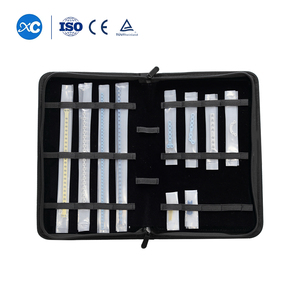
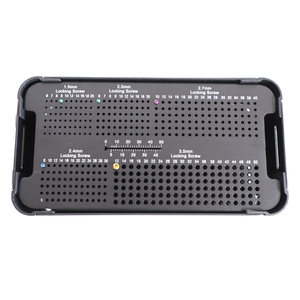
Absolutely. Each implant system family (e.g., 3.5mm Small Fragment LCP, Spinal Pedicle Screw System, CMF Plating) is available as a complete, surgery-ready kit. This includes ergonomically designed drill bits, taps, depth gauges, torque-limiting screwdrivers, bending irons, and custom-organized anodized aluminum sterilization boxes built to withstand repeated autoclave cycles (134°C high-pressure steam).
What is your typical production lead time and order fulfillment process?
Standard inventory items and high-volume fast-moving trauma SKUs are generally fulfilled within 7 to 10 business days. Custom OEM orders or non-standard implant sizes typically require 3 to 5 weeks for precision machining, surface treatment, quality validation, and packaging. All international shipments are dispatched via accredited express couriers or temperature/humidity-monitored air freight with full customs documentation.
How do you ensure batch-to-batch thread consistency between screws and locking plates?
Locking plate-screw compatibility depends on strict thread angle and pitch tolerances. We utilize dedicated multi-axis Swiss CNC machines programmed with identical tool paths, paired with go/no-go thread gauges and automated optical profile projectors during every machining cycle. This ensures 100% thread engagement without binding or cross-threading during intra-operative insertion.
Partner with a Trusted CE Certified Orthopedic Implant Manufacturer
Expand your hospital supply chain or medical distribution distribution network with high-precision, ISO 13485 certified titanium trauma plates, spinal systems, and custom OEM components. Connect with our senior export technical team today for catalogues, quotation matrices, and sample evaluation packages.